
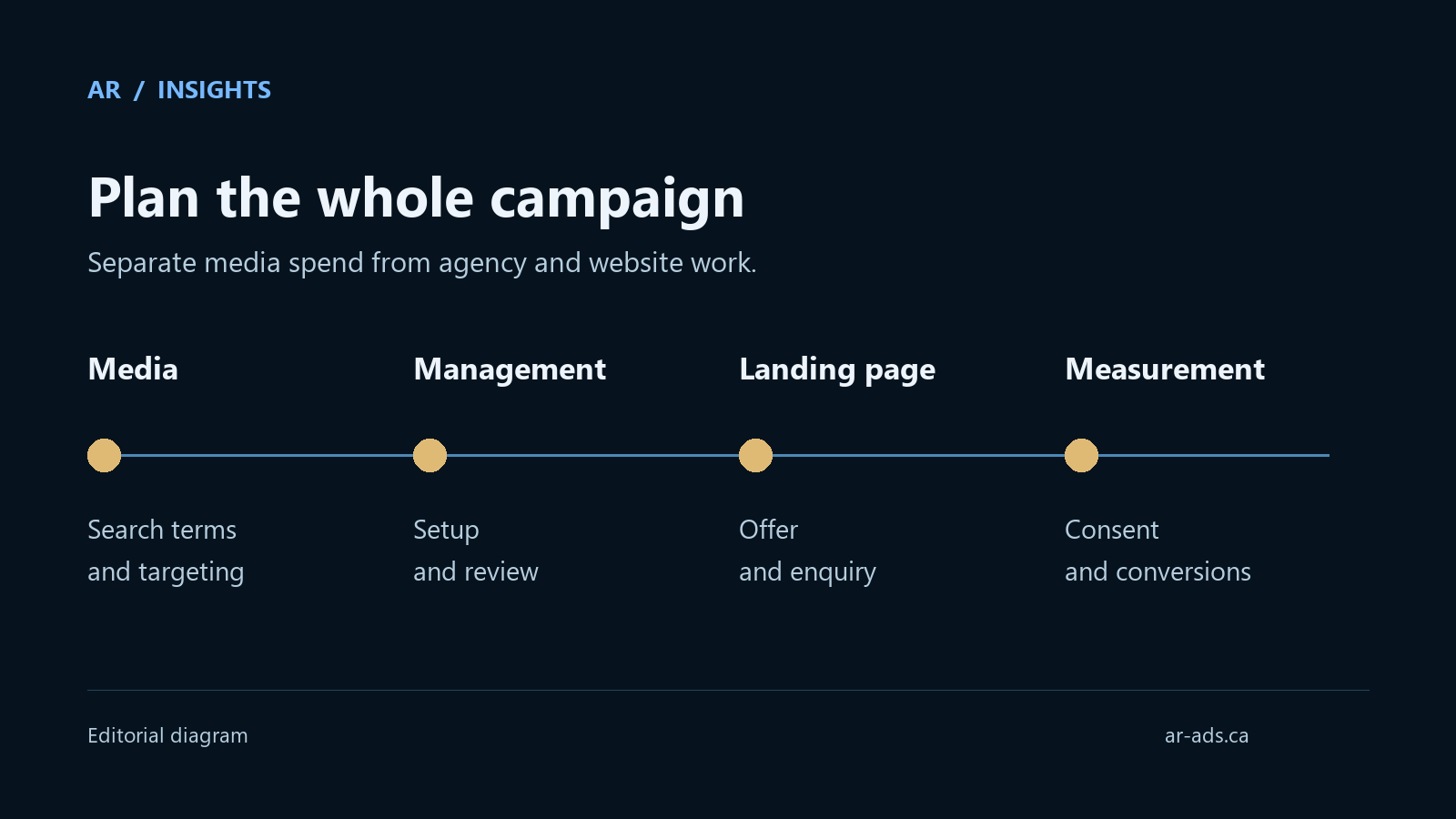
| Budget item | What it pays for | What to confirm |
|---|---|---|
| Media spend | Advertising delivered by Google | Account currency, campaign budget and billing arrangements |
| Agency work | Planning, setup, creative, management and reporting | Included work, reporting frequency and fee structure |
| Landing page and measurement | Destination page, enquiry flow and tracking implementation | Existing tools, required changes and separate project costs |
Choose one service to budget first
Write down what someone will search for, where you can deliver the service and what the landing page will offer. A firm booking consultations in Toronto may start with a different area and schedule from a contractor taking projects across the GTA.
Review how many new enquiries the team can respond to and which jobs fit the business. A broad list of services can spread a small campaign budget across unrelated searches. Begin with a defined offer so the campaign, destination and reporting have a shared reference.
Build the budget from current evidence
Ask for keyword forecasts with the intended locations, language, network and account currency recorded. Existing account data can add information about search terms, costs and actual enquiries. A forecast is a planning input; it does not establish a guaranteed cost per lead.
Set aside the media amount you can sustain during an agreed review period. Price management, landing-page work and measurement separately. Avoid treating another company’s advertising budget as a Toronto benchmark for your own service. Search demand, competition and the offer can differ.
Understand how an average daily budget is spent
For most campaigns using an average daily budget, Google describes a daily spending limit of twice that budget and a monthly spending limit of 30.4 times that budget. Actual spending can vary by day. Budget changes and other budget types have different rules, so check the campaign’s budget report.
For illustration only, a CAD 50 average daily budget gives a CAD 1,520 monthly spending limit for most such campaigns, with up to CAD 100 on an individual day. This is a calculation under those budget rules, not a recommended starting budget, an agency fee or a prediction of leads. Use the currency and budget type shown in your own account.
Source: Google Ads: average daily budgets and spending limits
Match location settings to the work you can accept
Selecting Toronto as a target does not, by itself, describe every location option. Google distinguishes people in or regularly in an area from people who have shown interest in it. For a business that needs nearby customers, review whether the Presence option fits the service.
Include neighbouring areas only when the business can serve them. Check location results and ask about unexpected enquiries outside the intended area. Location targeting uses several signals and does not guarantee complete geographic accuracy.
Define a qualified enquiry before launch
A phone-link click, a completed form and a confirmed appointment describe different actions. Agree on which events the account will measure and which actions the business will review as qualified. A test submission should confirm that the enquiry reaches the team before advertising directs people to that form.
Keep a simple follow-up record: service requested, location, whether the team could help and the eventual outcome. Calculate cost per qualified enquiry using the campaign spend and the qualified enquiries from the same review period. A dashboard conversion count alone cannot establish lead quality or sales.
Give the visitor a matching destination
A person searching for a particular service needs a page that explains that service, the coverage area and the next step. Review the mobile experience, the contact details and any booking or form connection. Existing service pages may already meet these needs.
If a dedicated landing page is required, scope the content, design, implementation and testing explicitly. Read the website quote guide linked below when comparing page work. Keep the agency’s management fee and the website project visible as separate decisions.
Set the review decisions in advance
Agree on a review date and on the evidence that would justify changing the campaign: relevant search terms, location fit, enquiry quality, website problems or a budget limit. Record what changed so a later comparison has context.
Bring AR your service priorities, existing advertising account if you have one, current landing page and a media budget boundary. Campaign planning can then address the offer, destination and measurement together. This guide does not promise a particular lead volume or return on advertising spend.
Bring this checklist to your agency discussion
- Priority service and the locations you can serve
- Media spend separated from management and page work
- Budget type, currency and review period
- Forecast assumptions or existing campaign data
- Working mobile destination and contact delivery
- Agreed conversion and qualified-enquiry definitions
- A person responsible for follow-up and lead feedback
Discuss the scope for your business.
Google Ads & PPC Management in Toronto ↗