
| Project | Typical work to define | Question for the quote |
|---|---|---|
| Campaign landing page | One offer, campaign copy, contact action and measurement | Does the scope include the copy, form connection and tracking setup? |
| Business website | Service pages, shared templates, navigation and a content system | How many unique templates and populated pages are included? |
| Website redesign | Content review, URL mapping, design, development and migration | Which existing pages, integrations and redirects will be carried over? |
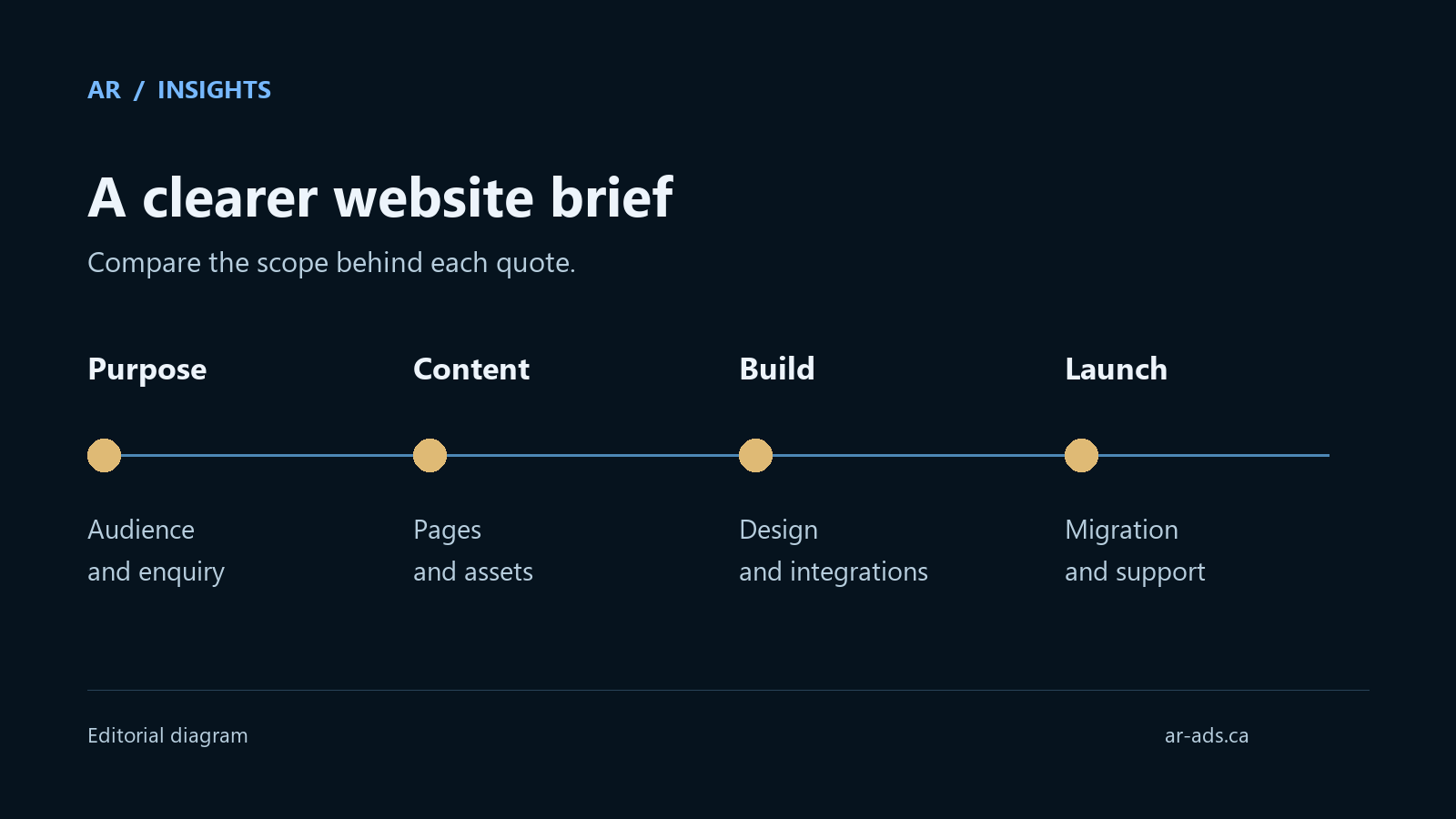
Start with the service and the customer
A Toronto accountant who wants consultation requests needs a different brief from a retailer with online checkout. Write down the service you want to sell, the customers you can serve and the action they should take. Name any appointment, payment or client-portal tools that must connect to the website.
For a local service business, distinguish Toronto coverage from wider GTA coverage. List the places you actually serve. Several interchangeable city pages add work to a quote without necessarily giving a customer useful information. Start with a clear service page and expand when there is a real local difference to explain.
Count templates as well as pages
A homepage, a service detail page and an article each need different layouts. Ten service pages may share one template, but someone still needs to write, format and review all ten. Ask for both counts: unique designs and populated pages.
A quote should also identify the content system, mobile layouts, navigation, forms and required integrations. Record which features are included, which are optional and what would trigger an additional charge. This makes proposals easier to compare when one agency prices a design and another includes the completed content.
Assign the writing and imagery
Content preparation is often a separate piece of work. Decide who supplies service descriptions, staff information, photographs and approved brand files. Identify material that can be reused and material that needs rewriting or production.
For a Toronto business serving more than one language, specify which pages need translation and who approves it. Obtain permission for client names, testimonials and project photographs before making them part of the website brief. Include image licensing and content entry in the quote where relevant.
Give an existing website a migration line item
Before a redesign, collect the current URLs, useful content and connected services. Ask who will map changed addresses, implement redirects and verify important pages after launch. Google recommends mapping old URLs to appropriate new destinations when page addresses change.
List the forms, booking links and other integrations that must continue working. Ask how they will be tested and who owns launch approval. A proposal that omits migration work can leave these tasks for the business to discover after the new design is finished.
Source: Google Search Central: moving a site with URL changes
Separate the build from recurring costs
Request separate figures for the website project, domain registration, hosting, software subscriptions and maintenance. Identify who pays third-party providers and whether tax is included. A maintenance agreement should explain updates, backups, support and the work that falls outside the agreement.
An SEO-ready website scope can include headings, metadata, crawlable links, canonical URLs and performance work. Ongoing keyword research, content publication and reporting require their own scope. Ask what will be handed over at launch and what would continue under a separate engagement.
Agree on reviews and handover
Specify who gives feedback, how it is collected and how many review rounds are included. A useful delivery schedule identifies the content and approval decisions that each stage depends on. Fixed dates need those dependencies to be understood.
At handover, confirm access to the domain, hosting, content system and source files as applicable. Ask for a short explanation of how to update the site and a record of the tools connected to it. Clarify the arrangements if you later move to another provider.
Prepare a brief that can receive a meaningful quote
Send your current website address, a list of the pages you need and the main contact action. Add the features that must work on day one, the content you already have and your intended launch window. State a budget boundary if you have one so the proposed scope can be discussed against it.
AR prepares website work around the pages, content and technical requirements agreed for the project. This guide does not publish an AR price list or a Toronto market average. A project quote needs your brief and the work that will be delivered.
Bring this checklist to your agency discussion
- Business goal and main enquiry action
- Unique templates and total populated pages
- Content, images and translation responsibilities
- Forms, bookings and other integrations
- Migration, redirects and launch testing
- Hosting, subscriptions, maintenance and tax
- Review rounds, access and handover
Discuss the scope for your business.
Web Design for Toronto Businesses ↗